Older homes
Older Aylesbury Homes and Lime Render: What to Know
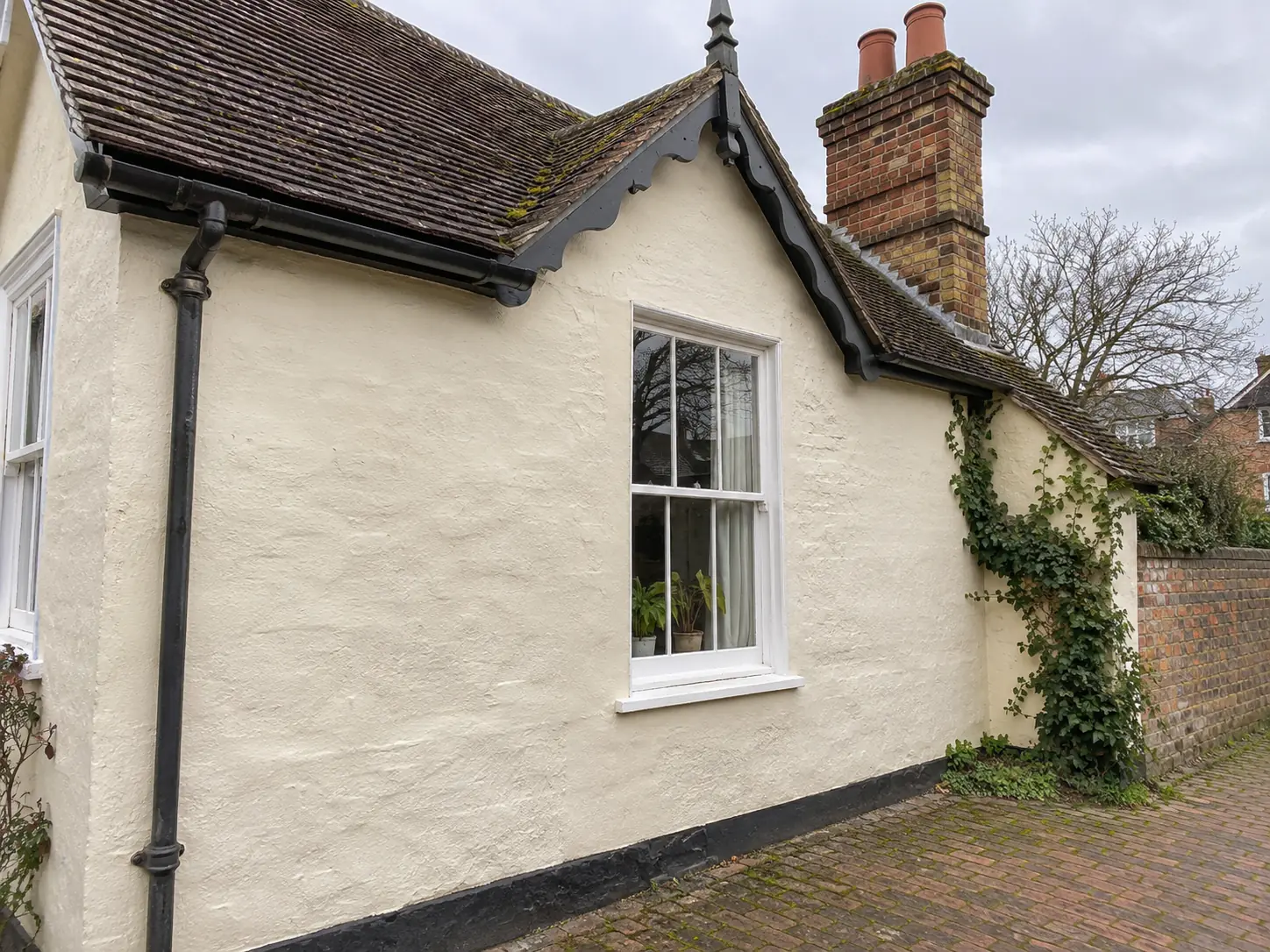
Older solid walls manage water differently from newer cavity ones, and published advice from Historic England and Buckinghamshire Council says render choice can matter. This page quotes it, says where it stops and lists questions for anyone proposing a finish.
Solid walls and cavity walls
Historic England explains the difference in one passage:
Many historic buildings are of traditional construction, with solid masonry, earth or timber-framed walls, or a combination of these. From the 19th century, some historic buildings were built with an early (narrow) form of cavity wall, with a wider version becoming standard in modern construction after the First World War.
Source: Historic England, Insulating Walls in Historic Buildings, updated 7 July 2026, viewed 19 November 2026.
So a Victorian terrace and a 1970s semi may need different answers. The age of the house, and what its walls are made of, is the first thing to tell a renderer. If the wall type is uncertain, saying so is more useful than guessing.
Moisture and drying
The same Historic England page warns about getting this wrong, in the context of insulating walls:
Installing unsuitable insulation in a building of traditional construction can hinder natural drying and may cause moisture to accumulate within the thickness of the building fabric.
Source: Historic England, Insulating Walls in Historic Buildings, viewed 19 November 2026.
That sentence is about insulation, not render alone, and the page does not rule on any render. The reasoning that carries over is simple: a wall that cannot dry may stay wet, so what goes on it deserves a question.
What the council’s appraisal says
Buckinghamshire Council’s appraisal for the Aylesbury conservation area goes further, and it speaks about render specifically:
…cement-based mortar or render used on historic buildings also lacks the ‘breathability’ of historic lime-based mortars which can also lead to trapped moisture and decay.
Source: Buckinghamshire Council, Aylesbury Conservation Area Appraisal and Management Plan (April 2026), paragraph 6.27, viewed 19 November 2026.
The appraisal covers the conservation area, and so its wording is about historic buildings there. It also records how render has been used in the town, in a passage on the canal basin area’s terraces:
Constructed of red brick in Flemish bond, though some have been unsympathetically rendered or painted.
Source: Buckinghamshire Council, Aylesbury Conservation Area Appraisal and Management Plan (April 2026), paragraph 8.116, viewed 19 November 2026.
Whether a given house counts as historic in the council’s sense is for the council to say. The rules page says how to ask.
Where lime comes in
Lime-based mortar and render are what the council’s sentence sets against cement, and Historic England mentions lime and earth plasters or renders
among the traditional finishes that older buildings were given. Source: Historic England, Insulating Walls in Historic Buildings. Neither page says that a particular wall must have lime, and neither gives a recipe or a lifespan. What they establish is that the question is worth asking, of any renderer proposing a finish for an older solid wall.
Questions to put to a renderer
- What is this wall made of, and what is the evidence?
- What is the present finish, cement-based or lime-based?
- What is proposed in its place, and why that product?
- How is the wall expected to dry once it is covered?
- Has anyone proposing it used it on a wall like mine?
- Where the property is listed or sits inside a conservation area, who is talking to the council?
Buckinghamshire Council runs a paid heritage advice service for work on listed buildings, locally listed buildings and in conservation areas, which is described on Buckinghamshire Council’s heritage advice page.
Describe the house
Its age, its walls and a photo of the side that worries you most.